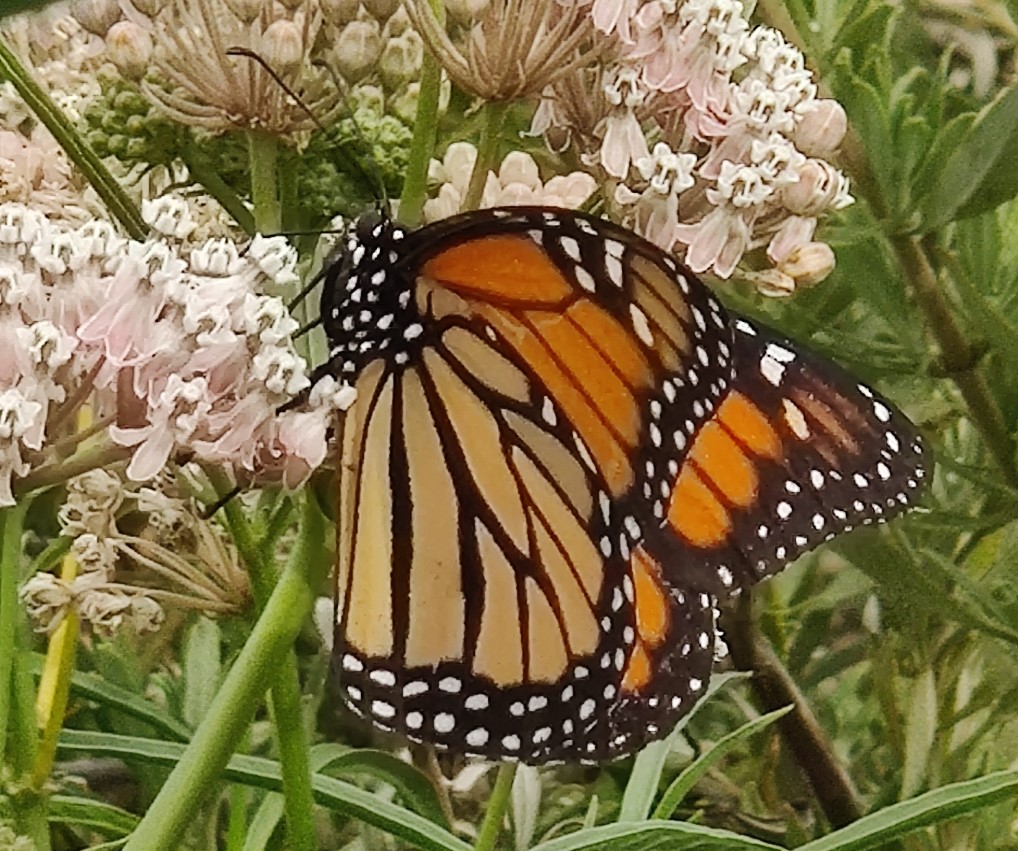

Photo by SH, July 2023
If you’re a butterfly you would think that blending in with your surroundings is the safest bet if you don’t want to be eaten. Why, then, do some butterflies do the opposite and step out in the most conspicuous wings imaginable?
In a strategy known as aposematic coloration, insects and other animals use bright, bold colors to warn predators to stay away. They may have toxic or venomous defenses in which case the coloration works as a visual “danger” message.

Photo by SH, February 2022
Susceptible predators who don’t yet understand this signal quickly learn after a bad experience or two to avoid these living red flags. Just google “barfing blue jays” for a classic example of learning the hard way.
This strategy is so successful that some non-toxic animals have developed their own bright disguises in a phenomenon called Batesian mimicry.
Monarch butterflies (Danaus plexippus) are a famous example of aposematic coloration. Carotenoids from their host plant, milkweeds (Asclepias spp.), are responsible for the vivid orange and black hues of their wings. Meanwhile sequestered cardiac glycosides from the same plant make monarchs toxic to most predators.
.jpg)
Steve Ryan from Groveland, CA, USA, CC BY-SA 2.0 https://creativecommons.org/licenses/by-sa/2.0, via Wikimedia Commons
Most, but not all. Monarchs are immune to milkweed toxins thanks to a mutation. Meanwhile some predators, like this male black-headed grosbeak (Pheucticus melanocephalus), have developed similar mutations that let them dine on monarch butterflies without the regrets.
Sorry blue jays.